0%

Choosing the right Narrow Aisle Pallet Racking system is not simply a space-saving exercise. It affects travel distance, truck selection, picking speed, safety, and future expansion. In a working warehouse, a few inches of aisle width can change equipment costs and daily productivity. A reach truck may operate comfortably in a seven-foot aisle, while a very narrow aisle truck may require stricter floor conditions and guidance systems.

James A. Tompkins, a respected warehouse design authority, offered a useful principle: “The warehouse is not a place to store inventory, but a place to process inventory.” That idea matters here. Narrow Aisle Pallet Racking should support smooth product movement, not merely create more storage locations. Rack height, pallet weight, SKU turnover, load accessibility, beam levels, and fire protection must all be reviewed together. Experienced buyers also check column protection, floor flatness, lighting, and forklift turning clearances before approving a layout.

This guide examines ten common types, including selective, double-deep, drive-in, push-back, pallet flow, mobile, and very narrow aisle configurations. Each option solves a different operational problem. Some increase density but reduce direct access. Others improve selectivity but need more floor area. The “best” system is rarely universal. That is easy to forget. A careful comparison should include actual aisle measurements, daily pallet movements, maintenance needs, and possible business growth. Even a well-designed solution can disappoint when real warehouse behavior differs from the original plan.
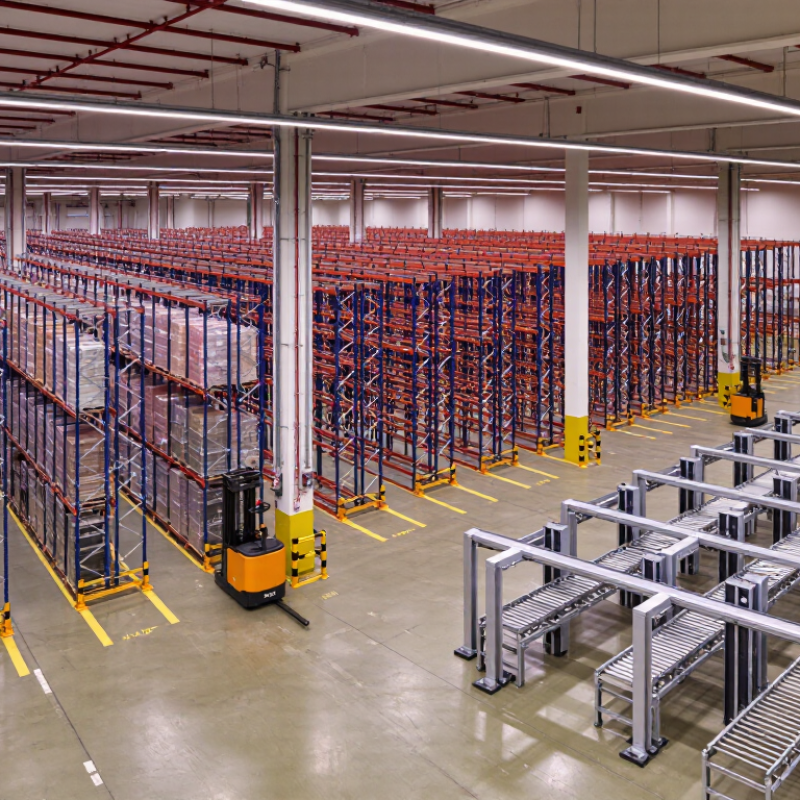
Top 10 Types of Narrow Aisle Pallet Racking for Buyers

Narrow Aisle Pallet Racking: Definition and Operating Principles

Narrow aisle pallet racking is a storage system designed for warehouses with limited travel space. Its aisles are typically narrower than those used by conventional forklifts. This arrangement increases pallet positions within the same building footprint. However, it requires suitable handling equipment and disciplined traffic control.

The operating principle is simple. Pallets remain stored on horizontal beams, while a narrow-aisle truck travels along defined lanes to place or retrieve loads. Guide rails, floor markings, or wire guidance help the truck stay aligned. Operators must check pallet condition, beam capacity, aisle clearance, and lifting height before daily use. Small errors matter here. A leaning pallet can obstruct an entire aisle.

The ten common configurations include selective, double-deep, drive-in, drive-through, push-back, pallet flow, mobile, carton-flow-supported, very-narrow-aisle, and satellite-assisted racking. Each type changes access speed, storage density, and stock rotation. Selective racks offer direct access, while drive-in systems improve density but reduce selectivity. Pallet flow supports first-in, first-out movement through inclined rollers. Very-narrow-aisle layouts need specialized trucks and precise installation. In my experience, buyers often focus on capacity and overlook turning space. That assumption can create delays. A practical design should match pallet dimensions, load frequency, floor flatness, fire protection, and operator skill. Even a well-engineered layout may need adjustment after real warehouse traffic begins.

Warehouse Conditions That Shape Narrow Aisle Rack Selection

Top 10 Types of Narrow Aisle Pallet Racking for Buyers

Warehouse conditions should guide narrow aisle rack selection, not catalog diagrams. Measure clear height, slab quality, fire protection, forklift turning radius, and SKU velocity. Selective, double-deep, very narrow aisle, drive-in, push-back, pallet flow, cantilever, mobile, shuttle, and mezzanine-supported systems solve different problems. However, not every “space-saving” design improves operations.

The 2023 U.S. Bureau of Labor Statistics reported 865 fatal work injuries in transportation and warehousing. This reinforces the need for rack protection, pedestrian separation, and controlled vehicle speeds. A narrow aisle may increase storage density, but it can also magnify alignment errors. The 2024 MHI Annual Industry Report identified labor availability and productivity as continuing supply chain concerns. Therefore, evaluate operator skill, automation readiness, and replenishment frequency before choosing higher-density storage. A beautiful layout can still fail.

Tips: Check the worst operating condition, not the average one. Test the rack with your largest pallet, lowest battery level, and busiest shift. Confirm sprinkler clearance and seismic requirements with a qualified engineer. Review aisle tolerances after installation. This step is often underestimated. Also, document damaged frames and uneven floors during inspections. Small defects become expensive surprises.

Top 10 Types of Narrow Aisle Pallet Racking for Buyers - Warehouse Conditions That Shape Narrow Aisle Rack Selection

No. Racking Type Typical Operating Aisle Pallet Access Best Warehouse Conditions Storage Density Selectivity Key Selection Considerations
1 Very Narrow Aisle (VNA) Pallet Rack About 1.5–1.8 m (5–6 ft) Direct access to every pallet High ceilings, smooth and level floors, high SKU variety, and predictable travel paths Very high Very high Requires specialized VNA equipment, precise floor tolerances, rack protection, and careful aisle-end planning.
2 Turret-Truck Pallet Rack About 1.5–1.8 m (5–6 ft) Direct access from both sides of the aisle High-bay facilities with high throughput, uniform pallet sizes, and stable operating conditions Very high Very high Suitable for high rack heights, but equipment cost, operator training, battery charging, and floor flatness must be evaluated.
3 Guided Narrow-Aisle Selective Rack About 1.8–2.1 m (6–7 ft) Direct access to every pallet Warehouses seeking improved cube utilization while retaining strong SKU-level access High Very high Wire or rail guidance can improve travel control; aisle width must match the truck, pallet overhang, and load dimensions.
4 Reach-Truck Selective Pallet Rack About 2.4–3.0 m (8–10 ft) Direct access to every pallet General-purpose distribution centers with mixed SKUs and moderate-to-high storage height High Very high A practical balance between aisle reduction and flexibility; confirm lift height, residual capacity, mast clearance, and turning radius.
5 Double-Deep Selective Rack About 2.7–3.3 m (9–11 ft) Two pallets deep; front pallet normally accessed first Fewer SKUs, multiple pallets per SKU, and medium-to-high inventory turnover Very high Moderate Needs a suitable reach truck and load backstops; inventory rotation and pallet stability are important.
6 Mobile Pallet Racking One active aisle, commonly about 2.7–3.3 m (9–11 ft) Direct access when the required aisle is opened High land cost, limited floor area, low-to-medium throughput, or temperature-controlled storage Extremely high High Requires a reinforced, level floor, electrical controls, safety interlocks, and an operating plan for aisle opening time.
7 Drive-In Pallet Rack Truck enters the storage lane; aisle width depends on equipment Limited access; last-in, first-out by lane High quantities of the same or similar SKU, low variety, and low-to-medium turnover Extremely high Low Best for stable, non-fragile loads; impact protection, lane depth, pallet quality, and fire-code requirements need close review.
8 Push-Back Pallet Rack About 3.0–3.6 m (10–12 ft) Front access; pallets stored several positions deep Multiple pallets per SKU, medium turnover, and a need to reduce forklift travel Very high Moderate Works well where last-in, first-out is acceptable; verify pallet weight, platform depth, cart condition, and load compatibility.
9 Pallet Flow Rack Operating aisle typically about 2.7–3.3 m (9–11 ft) First-in, first-out through separate load and pick aisles High-throughput goods, expiration-sensitive inventory, and consistent pallet dimensions High High Requires accurate pallet specifications, compatible roller design, lane-depth planning, and regular brake or wheel inspection.
10 Shuttle Pallet Rack Truck aisle commonly about 3.0–3.6 m (10–12 ft) Automated shuttle movement within deep storage lanes High-density storage, repetitive pallet movements, cold rooms, and limited forklift access inside lanes Extremely high Moderate to high Requires compatible pallets, reliable battery management, controls integration, maintenance access, and a suitable safety system.

Note: Aisle dimensions are planning ranges rather than final design values. The required width depends on the selected truck, pallet dimensions, load overhang, rack height, turning geometry, floor conditions, and applicable safety regulations.

Ten Narrow Aisle Pallet Racking Types and Their Distinct Uses

Top 10 Types of Narrow Aisle Pallet Racking for Buyers

Ten narrow aisle pallet racking types serve different storage and handling needs. Selective racking suits warehouses requiring direct access to every pallet and frequent SKU changes. Very narrow aisle racking uses turret trucks to increase storage height within tight aisles. Double-deep racking stores backup pallets behind front positions, reducing access speed but improving density. Drive-in racking supports high-volume products with limited variety and usually follows a last-in, first-out pattern. Drive-through racking allows forklifts to enter both sides, making it more suitable for first-in, first-out rotation.

Push-back racking uses nested carts for multiple pallets at each lane, helping store medium-volume products with several SKUs. Pallet flow racking uses rollers and gravity, supporting controlled FIFO movement for food, beverages, and dated inventory. Mobile racking places rack rows on powered bases, creating one active aisle and saving floor space. It moves slowly.

Shuttle racking uses semi-automated carts to transport pallets deep inside lanes, reducing forklift travel and improving high-density storage. Structural pallet racking uses stronger steel components for heavy loads, demanding careful floor and beam calculations. In practice, aisle width, pallet weight, turnover, and equipment clearances must be measured together. A rack layout that looks efficient on paper may delay replenishment during peak hours. Leave room for damaged pallets, uneven loads, and operator visibility. Regular inspections should check beam locks, upright damage, floor anchoring, and load signs. No design is perfect. Reassess the system after real traffic data appears.

Top 10 Types of Narrow Aisle Pallet Racking for Buyers

The chart compares typical clear aisle widths used in warehouse layouts. Actual requirements vary with pallet dimensions, forklift type, building columns, load height, and local safety standards.

Distinct Uses

  1. Selective Pallet Racking: Best for high SKU variety and direct access to every pallet.
  2. Narrow Aisle Racking: Suitable for warehouses seeking greater storage density while retaining pallet selectivity.
  3. Very Narrow Aisle Racking: Designed for maximum space utilization with specialized guided or turret trucks.
  4. Double-Deep Racking: Useful for storing multiple pallets of the same product and reducing the number of aisles.
  5. Drive-In Racking: Appropriate for high-volume, low-variety inventory managed on a last-in, first-out basis.
  6. Drive-Through Racking: Works well when pallets are loaded from one side and retrieved from the other.
  7. Push-Back Racking: Provides multiple pallet positions per lane with efficient front-side loading and retrieval.
  8. Pallet Flow Racking: Ideal for first-in, first-out inventory rotation, especially in food and beverage operations.
  9. Mobile Pallet Racking: Uses movable rack bases to reduce fixed aisles and improve floor-space utilization.
  10. Automated Pallet Shuttle Racking: Suited to high-density storage where shuttle vehicles handle pallet movement inside deep lanes.

Comparing Capacity, Access, Automation, and Space Efficiency

Top 10 Types of Narrow Aisle Pallet Racking for Buyers

Comparing Capacity, Access, Automation, and Space Efficiency

Narrow aisle selective racking offers direct access to every pallet, but it sacrifices some storage density. Very narrow aisle racking uses tighter lanes and guided trucks, improving floor utilization while demanding accurate driving. Double-deep racking stores more pallets behind each other, although rear pallet access becomes slower. Choose it for stable products with moderate rotation.

Drive-in and drive-through systems provide high density for uniform loads. Drive-in follows last-in, first-out handling, while drive-through can support first-in, first-out movement. Push-back racking increases capacity without requiring deep lanes, but operators cannot reach every pallet immediately. Pallet flow racking uses rollers and gravity, making it useful for date-sensitive inventory. It needs careful loading.

Mobile racking moves complete rows, creating one active aisle. It saves substantial floor space, yet access depends on opening the correct lane. Shuttle racking improves density and reduces forklift travel through semi-automated pallet movement. Automated stacker-crane systems offer strong height utilization and consistent access, but installation and maintenance require serious planning. Hybrid narrow aisle layouts can combine these options.

Capacity figures alone can mislead buyers. Measure pallet weight, load dimensions, turnover, aisle width, ceiling height, and fire protection requirements. I have seen layouts look efficient on paper, then lose capacity because columns blocked forklift visibility. Automation is not always better. A manual system may outperform it when inventory changes often or daily volume remains modest. Test one representative aisle before approving the full design.

Buyer Checklist for Choosing and Implementing the Right System

Choosing among selective, double-deep, push-back, pallet-flow, and mobile narrow aisle racking starts with your building, not a catalogue. Measure clear height, column spacing, floor flatness, aisle width, and emergency access.

Measure twice. Do not guess.

Record each pallet’s weight, dimensions, stacking limits, and daily movement. Then match the system to your equipment. Reach trucks may suit very narrow aisles, while guided trucks require compatible floors and operating controls. Check beam capacity, upright protection, pallet condition, and load signage. Ask a qualified rack engineer to verify the design against local building, fire, and workplace requirements. A cheaper layout can become expensive after installation.

Plan implementation before ordering steel. Mark the proposed footprint on the floor and test turning paths with the actual truck. Confirm sprinkler clearance, lighting, charging areas, pedestrian routes, and future expansion space.

Train operators before live loading begins, and inspect frames, beams, pins, and guards regularly. One overlooked detail is pallet variation; damaged or uneven pallets can change real capacity.

I have seen layouts that looked efficient on paper but slowed picking because replenishment traffic crossed every aisle. Leave room for revision. Review travel time, damage records, and congestion after the first month, then adjust the operating plan.

FAQS

What is narrow aisle pallet racking?

It stores pallets in tighter lanes than conventional layouts. A guided or specialized truck places and retrieves each load. More positions fit inside the same building footprint. Space improves. Maneuvering becomes less forgiving.

How does narrow aisle racking operate?

Pallets rest on horizontal beams. Trucks follow floor markings, guide rails, or wire guidance. Operators check pallet condition, beam capacity, clearance, and lifting height. A leaning pallet can block an entire aisle.

Which racking type provides direct pallet access?

Selective racking provides direct access to every pallet. It supports flexible picking and changing inventory. However, it usually stores fewer pallets than denser systems. Access matters more than maximum capacity in many warehouses.

When is double-deep racking suitable?

Double-deep racking stores one pallet behind another. It suits stable products with moderate turnover. Rear pallets take longer to reach. Do not choose it for constant individual-pallet picking.

How do drive-in and drive-through systems differ?

Drive-in systems usually follow last-in, first-out handling. Drive-through systems can support first-in, first-out movement. Both work best with uniform loads and high storage density. Selectivity is limited.

What equipment is needed for very narrow aisles?

Very narrow aisles require compatible specialized trucks. Guided trucks also need suitable floors and operating controls. Check turning paths using the actual truck before installation. A catalogue drawing is not enough.

How should buyers compare storage capacity?

Measure pallet weight, dimensions, turnover, aisle width, and ceiling height. Also check column spacing, floor flatness, fire protection, and emergency access. Capacity figures alone can mislead. Blocked visibility may erase expected gains.

Is automated racking always the best choice?

No. Automated systems can improve height use and access consistency. They also require careful installation, maintenance, and planning. Manual racking may suit modest volumes or frequently changing inventory. Automation is not automatically better.

What should happen before the system goes live?

Mark the proposed layout on the floor. Test truck routes, turning space, lighting, charging areas, and pedestrian paths. Train operators before loading begins. Inspect frames, beams, pins, guards, and pallets regularly.

How should the layout be reviewed after installation?

Review travel time, damage records, congestion, and replenishment routes after one month. Watch for traffic crossing every aisle. Adjust the operating plan when real movement differs from the design. Paper efficiency can be misleading.

Conclusion

Narrow Aisle Pallet Racking is a space-efficient warehouse storage solution designed to increase pallet capacity while preserving organized access to goods. By reducing aisle width and using suitable handling equipment, warehouses can make better use of floor area and vertical height. Selecting the right system depends on factors such as building dimensions, ceiling height, pallet size and weight, inventory turnover, equipment maneuverability, floor conditions, and required safety clearances.

This guide introduces ten types of narrow aisle pallet racking and explains their distinct applications, from high-density storage and selective access to mobile, automated, and specialized configurations. It compares each option according to storage capacity, accessibility, automation potential, installation complexity, and space efficiency. A practical buyer checklist also covers load requirements, workflow analysis, future expansion, operator training, safety planning, maintenance, and total cost evaluation, helping businesses choose and implement a system that matches their operational needs.

Amelia

Amelia

Amelia is a professional marketing specialist with a strong understanding of the company’s products, services, and the needs of the people they are designed to support. She regularly contributes expert articles to the company website, sharing practical insights, explaining product features, and......