Very Narrow Aisle Racking helps warehouses store more pallets without expanding their footprint. Aisles are often much narrower than those used with conventional forklifts, so every inch of clearance matters. The right system can improve storage density and keep pallet access organized. But the rack alone does not determine performance.
This guide explores common types used in Chinese warehouse projects, including selective VNA layouts and systems paired with turret or articulated trucks. Each option suits different pallet volumes, picking patterns, and handling needs. A turret truck may serve high racks in especially tight aisles, while an articulated truck can offer more flexibility across working areas. Details vary by manufacturer and site.
Fit comes first. Buyers should compare rack height, beam capacity, pallet dimensions, and aisle width with the actual equipment specifications. Floor flatness also matters; small variations can affect truck movement and safe operation. Rack drawings and load data should be checked by qualified professionals before installation. Local building, fire, and workplace requirements need review as well. More density is not always better. If access becomes slow or the equipment is poorly matched, the apparent space savings may not translate into smoother work. This overview offers a practical starting point, not a substitute for a site survey. The best choice is the one that fits the building, inventory, and daily workflow—with room to reconsider assumptions when real operating conditions differ from the plan.
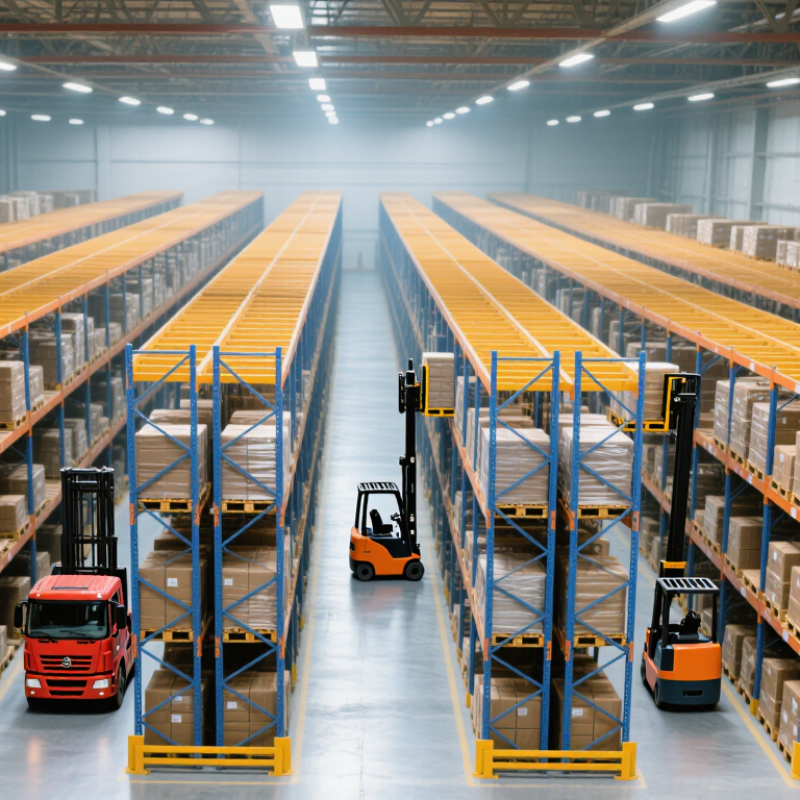
Very narrow aisle racking uses closely spaced rows to increase storage density while preserving access to individual pallets. Its defining feature is the narrow travel lane, matched to a suitable turret or articulated truck. Aisle width should follow the truck’s turning envelope, pallet dimensions, and load overhang—not a generic rule of thumb. Measure twice.
The frames are tall, with beams positioned to suit the warehouse’s clear height and the required number of pallet levels. Bracing and anchors help resist operational forces, while upright guards protect vulnerable frame ends. Rails or floor-guidance systems can keep trucks aligned, but they do not correct an uneven slab. Floor flatness and rack installation tolerances matter. Small errors grow.
Good design also accounts for sprinkler clearance, lighting, pedestrian routes, and safe access for inspections. Clear load signs should state permitted beam and bay capacities. In practice, teams sometimes focus on adding another storage level before checking how loads will be handled at height. That assumption deserves a second look: truck capability, visibility, and safe retrieval all shape the workable design. Regular checks for impact damage, loose connections, and displaced loads help keep the system reliable.
Typical aisle-width planning ranges by forklift type
Bars show the midpoint of each indicative aisle-width range: counterbalance trucks, 3.0–3.5 m; reach trucks, 2.6–3.0 m; and VNA turret trucks, 1.5–1.8 m. VNA layouts use narrow aisles and specialized trucks to increase storage density. Actual aisle requirements depend on the truck model, pallet dimensions, load overhang, and site conditions.
Chinese warehouses commonly use single-deep selective racks for very narrow aisle (VNA) operations. Each pallet remains directly accessible, while guided turret or articulated forklifts work in aisles often around 1.5–1.8 metres wide. Actual clearance depends on the truck, pallet dimensions, floor flatness, and rack protection. Measure loaded pallets, not just the nominal pallet size.
Double-deep racks place pallets two positions deep, increasing storage density but reducing direct access to rear pallets. They suit inventory with fewer product lines and predictable rotation. For high-throughput sites, single-deep VNA may be easier to manage. The 2024 MHI Annual Industry Report, based on more than 700 supply-chain professionals, identifies automation and robotics as important investment areas. That supports evaluating guided trucks and warehouse control systems, but automation cannot fix poor slotting or uneven floors.
Tips: Mark aisle edges and test a loaded truck through the tightest turn before installation. Check rack clearances against the truck maker’s specifications. A drawing can look perfect. Real pallets often don’t. One common mistake is choosing the narrowest aisle before confirming emergency access and replenishment routes.
Very narrow aisle racking increases storage density by placing tall racks close together, but the truck needs accurate guidance. Two common options are rail-guided and wire-guided systems. The right choice depends on the floor, truck design, and daily handling pattern. The aisle stays tight.
Rail-guided trucks follow steel rails fixed along the aisle floor. The rails help keep the truck aligned and reduce the risk of rack contact. They suit operations with stable routes and predictable pallet movement. However, rails need sound installation and regular checks. A loose fixing or damaged section can disrupt travel, so maintenance access should be planned before the racks are installed.
Wire-guided systems use an energized wire embedded in the floor. Sensors on the truck detect its signal and steer along the aisle. This can leave the floor clear of guide rails, which may help when layouts change. Yet the wire requires careful installation, and floor repairs can affect its path. Small details matter. Pallet overhang, uneven concrete, and aisle-end turning space all deserve attention. In practice, guidance does not solve every handling problem. A site survey and trial run can reveal issues that drawings miss, though even these checks may not predict every shift pattern.
Very narrow aisle (VNA) trucks work in spaces where conventional forklifts cannot turn comfortably. A turret-style truck travels straight along the aisle while its fork assembly rotates to pick or place pallets on either side. Depending on the system, guidance may come from floor rails, an inductive wire, or operator steering. The operator raises the load, aligns the forks with the pallet openings, and withdraws it before moving on. Small alignment errors matter. Clearance is unforgiving.
The truck’s aisle width must match its turning method, load dimensions, rack layout, and required safety clearance. A pallet that overhangs by a few centimeters can obstruct travel or strike a rack upright. Before operation, teams should verify guidance, inspect the aisle floor, and check that loads are stable and evenly positioned. OSHA estimates that powered industrial truck incidents in the United States cause about 85 fatalities and 34,900 serious injuries each year. That figure covers more than VNA equipment, but it underlines why speed should never replace visibility and controlled movement. Operators also need practical training in their specific aisle layout; classroom instruction alone can miss awkward corners and uneven floor joints.
Compare common rack configurations and truck guidance methods used in very narrow aisle (VNA) warehouses. Aisle widths below are indicative planning ranges; the required width depends on the truck model, pallet dimensions, load overhang, and operating clearances.
| Racking configuration | Pallet access and storage | Indicative aisle width | Typical truck and guidance | How the truck operates | Common application |
|---|---|---|---|---|---|
| Single-deep selective VNA | One pallet deep at each rack face; each pallet position can be accessed directly. | About 1.5–1.8 m (5–6 ft) with a suitable VNA turret truck; verify against the truck’s working-aisle specification. | Man-up or man-down turret truck; mechanical rail guidance or floor-embedded wire guidance. | The truck travels along the aisle and raises or rotates its fork head to place or retrieve pallets on either side, without turning the truck body within the aisle. | Warehouses needing direct access to many SKUs and high storage density. |
| Double-deep VNA | Two pallets deep at each rack face; the front pallet must be moved before the rear pallet can be accessed. | Often similar to the selected VNA truck aisle, but rack depth and truck reach requirements must be assessed separately. | Reach-capable turret truck or another truck specifically designed for double-deep handling; guidance may use rails or wire. | The truck positions in the aisle and extends its reach mechanism past the first pallet to handle the second position. | Higher-density storage where some loss of immediate access to every pallet is acceptable. |
| VNA pallet-flow configuration | Pallets move by gravity on inclined roller lanes; loading and retrieval are generally from opposite ends of a lane. | The operating aisle is determined by the selected VNA truck and load; flow lanes add depth behind the rack face. | VNA turret truck or other compatible pallet-handling truck; guidance is commonly used in the narrow operating aisle. | The truck loads pallets at the replenishment end or retrieves them at the picking end; rollers advance pallets through the lane. | High-throughput, date-sensitive stock managed on a first-in, first-out basis. |
| VNA pallet-shuttle configuration | A powered shuttle moves pallets within deep storage channels; the truck typically serves the channel entrance. | Depends on the VNA truck and aisle layout; shuttle channels increase storage depth without requiring the truck to enter each channel. | VNA turret truck or compatible lift truck, paired with a shuttle system; aisle guidance may be used. | The truck places or collects the shuttle at the channel face, while the shuttle transports pallets inside the channel. | Deep-lane storage with repeated pallet types and a need to reduce truck travel into storage channels. |
| VNA storage with articulated truck access | Usually selective pallet racking; some articulated trucks can work both in aisles and in wider staging areas. | Commonly around 1.8–2.1 m (6–7 ft), depending on truck design, pallet size, and load handling. | Articulated forklift; some models need no fixed aisle guidance. | The articulated mast or fork assembly turns to place or retrieve loads while the truck remains aligned with the aisle. | Operations that value flexibility between narrow storage aisles and wider receiving or dispatch areas. |
Planning note: VNA aisle width is not a universal fixed measurement. Confirm the required working aisle using the truck manufacturer’s specification and the actual pallet and load dimensions. Rack height, floor flatness, guidance equipment, clearances, and local safety requirements should also be checked during warehouse design.
Choosing very narrow aisle (VNA) racking starts with the building, not a catalogue. Measure clear height, column positions, floor flatness, and slab capacity. Then check the truck’s turning envelope and required operating aisle. A few centimetres can affect safe travel. Review pallet size, load weight, SKU mix, and picking frequency, too. Fast-moving goods may need easier access than reserve stock.
In China, confirm local building, fire-safety, and project-specific seismic requirements with qualified professionals. MHI’s 2024 Annual Industry Report found that 55% of surveyed professionals planned to increase supply-chain technology investment. The survey is global, not China-specific, but it highlights why system compatibility matters. Check that guidance equipment, inventory software, and maintenance support fit the warehouse plan. I would not assume maximum density is always best; slower picking or difficult repairs can erase the space gains.
It uses closely spaced, tall rack rows to store more pallets while keeping individual loads accessible. The travel lanes are narrow. Measure twice.
Match it to the truck’s turning envelope, pallet dimensions, load overhang, and required clearance. A generic rule may not fit your site.
Trucks may follow floor-mounted rails, an embedded wire, or operator steering. Each option needs to suit the floor and daily handling pattern.
Check the floor condition, rail fixing, and future maintenance access. A loose section can interrupt truck travel.
It travels straight along the aisle while its fork assembly turns toward a rack. The operator aligns the forks, lifts the load, and withdraws it carefully.
Uneven concrete can affect truck guidance and alignment. Rails cannot correct an uneven slab. Small floor differences may cause trouble.
Plan for sprinkler clearance, lighting, pedestrian routes, and inspection access. Post clear beam and bay capacity signs.
Look for impact damage, loose connections, displaced loads, and uneven pallet positioning. A trial run helps, but it may not reveal every shift pattern.
Very Narrow Aisle Racking helps warehouses make better use of available floor space by reducing aisle widths while keeping goods accessible for storage and retrieval. Its design typically combines tall rack structures with specialized handling equipment, allowing operators to use vertical space efficiently. Chinese warehouses may use different configurations depending on inventory profiles, building dimensions, load requirements, and the movement of goods.
VNA systems commonly rely on either rail guidance or wire guidance to help trucks travel accurately along narrow aisles. Trucks move within these restricted spaces to store and retrieve pallets, while operators follow the guidance system and work with designated entry and exit areas. When choosing a solution, warehouse planners should consider aisle layout, rack height, pallet dimensions, floor conditions, equipment compatibility, throughput needs, safety procedures, and opportunities for future expansion. The right combination can support efficient operations without compromising access or workplace safety.