Featured Industrial Racking Solutions
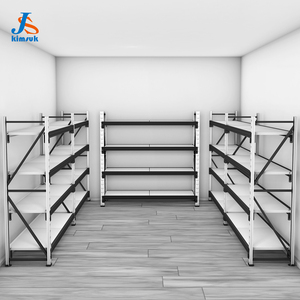
Selective & Cantilever Hybrid Storage Rack
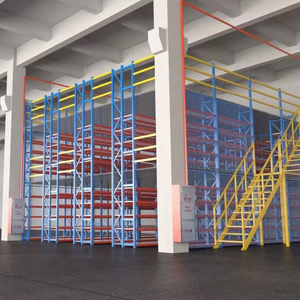
Multi-Tier Modular Mezzanine Platform
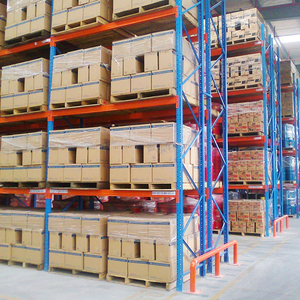
2000kg Load-Row Connected Heavy-Duty Rack
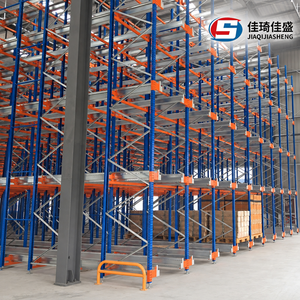
Multi-Level Radio Shuttle Automated Rack
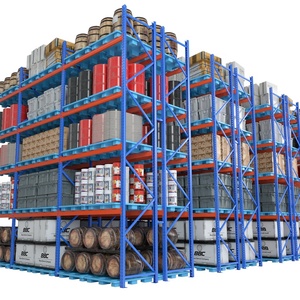
Multilevel Stacking Industrial Pallet System
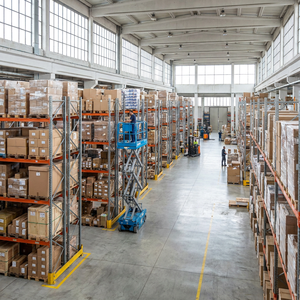
Industrial Heavy-Duty Beam Racking System
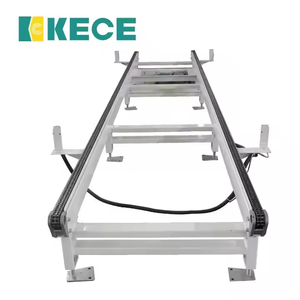
Automated Heavy-Duty Pallet Chain Conveyor
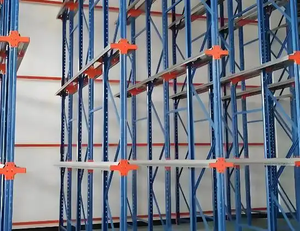
Very Narrow Aisle (VNA) High-Bay Racking
1. Executive Overview & Structural Dynamics of Four-Way Shuttle Systems (4D AS/RS)
In modern supply chain engineering, traditional static pallet storage often fails to balance volumetric density with dynamic throughput capacity. As global logistics transitions toward total automation, the Four-Way Shuttle Racking System (4D AS/RS) represents the pinnacle of high-density automated storage and retrieval technology. Unlike legacy 2-way shuttle systems limited to linear back-and-forth movement within a single channel, a Four-Way Shuttle vehicle possesses autonomous bi-directional movement across both longitudinal and transverse rails.
By integrating specialized vertical lifters (recirculating or reciprocating elevators), the 4D shuttle vehicle transitions effortlessly between warehouse rack levels and cross-aisles. This creates a fully integrated 3D spatial matrix capable of executing automated pallet storage, retrieval, stock rotation, and dynamic order-consolidation with zero forklift dependency inside the rack lanes.
Mechanical Subsystems & Hardware Architecture
A commercial-grade Four-Way Shuttle Storage System engineered by Zenithrack comprises four interconnected architectural layers:
- Precision Cold-Rolled Structural Racking: Fabricated using high-tensile Q235B or Q355B steel profiles, designed with integrated dual-direction drive rails and micro-tolerance guide track alignments.
- Autonomous 4-Way Shuttle Vehicles: Equipped with dual-wheel set shifting mechanisms, optical laser positioning sensors, integrated hydraulic pallet lifters, and onboard PLC controllers.
- Vertical Reciprocating Elevators (Hoists): Heavy-duty high-speed lifts carrying shuttles and loaded pallets (up to 1,500 kg per payload) between rack tiers at speeds up to 1.5 m/s.
- Integrated WCS/WMS Software Suite: Fleet management algorithms providing dynamic path routing, real-time battery status monitoring, traffic collision prevention, and ERP integration.
Industrial Storage Technology Comparison Matrix
| Storage Technology | Spatial Utilization (%) | Throughput Speed (Pallets/Hr) | Forklift Dependency | Cold Storage (-30°C) Suitability | CAPEX Efficiency |
|---|---|---|---|---|---|
| 4-Way Radio Shuttle AS/RS | 85% - 92% | Ultra High (Automated) | Zero (Inside Rack Matrix) | Excellent | High ROI / Modular Scalability |
| 2-Way Radio Shuttle Rack | 70% - 80% | Moderate (Manual Lifter) | High (Forklift Aisle Access) | Good | Moderate Initial CAPEX |
| Standard Selective Pallet Rack | 35% - 40% | Low (Manual Forklift) | 100% Manual Handling | Poor (High Energy Waste) | Low Initial CAPEX |
| Stacker Crane AS/RS (Miniload) | 80% - 85% | Very High | Zero | Moderate | Extremely High CAPEX |
Dynamic Fleet Management
Supercapacitor Power System
Seismic & Structural Safety
2. Strategic Procurement Trends in Global Automated Storage (2025–2030)
As global supply chains navigate labor shortages, rising land prices, and energy cost volatility, corporate procurement officers are shifting away from static racking purchases toward modular automation investments. Buyers evaluating warehouse infrastructure for 2025–2030 are driven by three fundamental trends:
A. Modular "Pay-As-You-Grow" Scalability
Unlike rigid stacker-crane AS/RS systems that require massive upfront capital commitment and fixed aisle structural geometry, Four-Way Shuttle systems offer unmatched modular flexibility. Enterprises can install the complete structural racking matrix today and dynamically add additional shuttle vehicles to the grid as throughput volume grows. This decouples storage capacity from operational throughput capacity, dramatically lowering the Initial Risk Barrier (IRB) for enterprise procurement.
B. Deep Cold-Chain Energy Conservation (-30°C)
Cold storage facilities incur immense refrigeration costs. Because 4-Way Shuttle systems eliminate forklift aisles and operating overhead space, the thermal footprint per pallet position drops by up to 40%. Specialized cold-chain shuttle vehicles manufactured by Zenithrack utilize low-temperature synthetic lubricants, frost-resistant PLC components, and thermal-insulated sensor housings engineered for continuous operating cycles down to -30°C.
C. Micro-Fulfillment & Omnichannel Fulfillment Integration
With the acceleration of e-commerce and same-day delivery demands, logistics hubs require high-speed order picking. Modern 4-Way Shuttle systems seamlessly interface with Goods-to-Person (G2P) pick stations, robotic arm palletizers, and automated guided vehicles (AGVs), delivering end-to-end automated material handling from inbound dock to outbound staging.
3. Technical & Procurement FAQ for Enterprise Buyers
4. Zenithrack Manufacturing Excellence & Global Trust
Zenithrack Industrial Equipment Co., Ltd. stands as a premier direct manufacturer and global exporter of high-precision warehouse racking systems. Operating from an expansive 8,000 m² modern manufacturing facility in Dongguan, China, we combine over 15 years of structural racking heritage with cutting-edge automated roll-forming and robotic welding technology.
Rigorous Quality Assurance Protocols
Quality is engineered into every component that leaves our factory floor. Our quality management system covers every stage of production:
With an annual production output exceeding CNY 100 million and a dedicated workforce of over 75 structural engineers, QC technicians, and international logistics coordinators, Zenithrack has earned the long-term trust of fortune-level enterprises including BYD, FedEx, SF Express, Cooper Tire, and Midea Group.